Late 18th-Century English Toleware Shepherd’s Lantern | Punched Tin Candleholder
A late 18th-century English antique tin lantern.
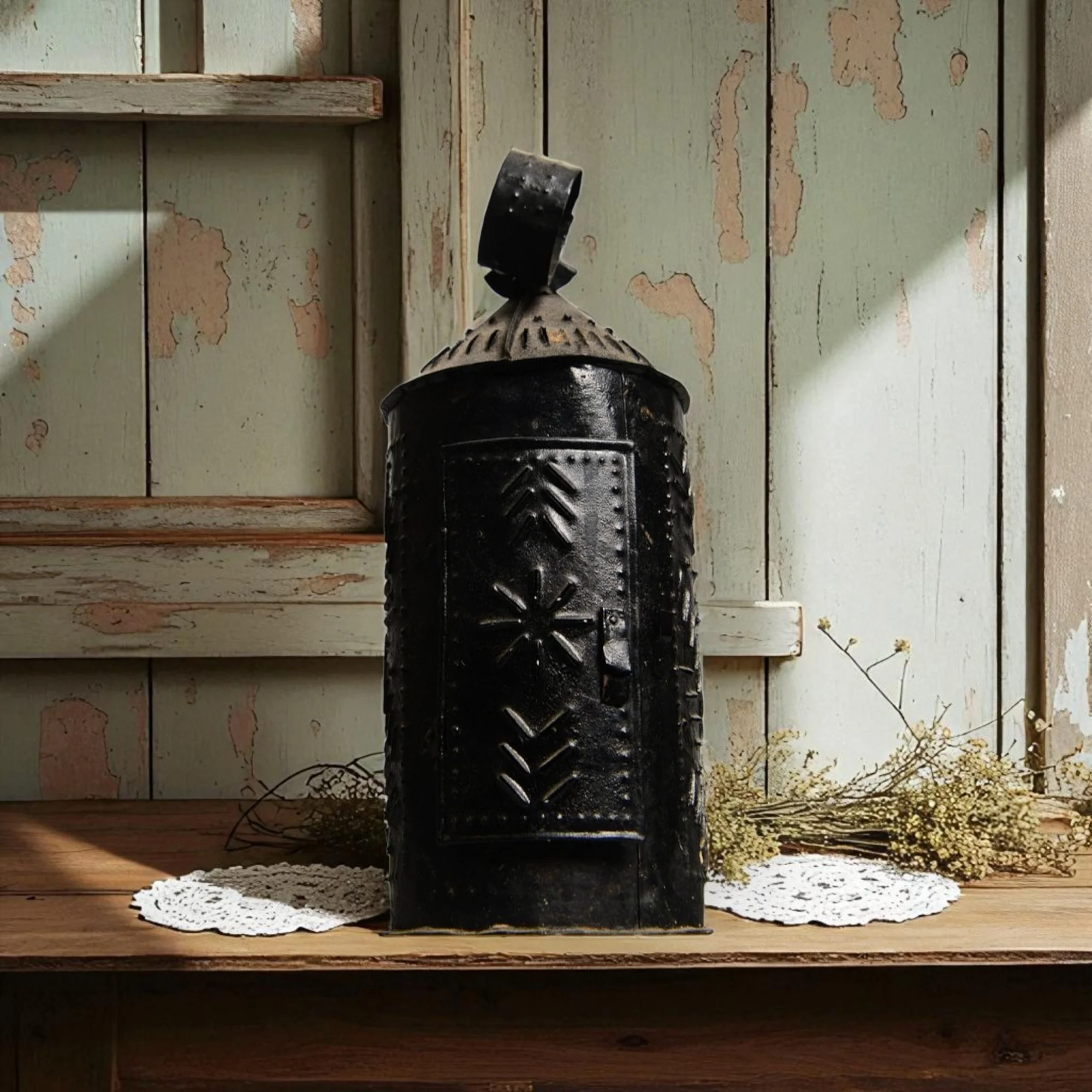
This antique tin lantern is a charming relic of old-world craftsmanship. Its cylindrical body, adorned with a herringbone texture, hints at a time when both utility and beauty mattered, even in the most everyday objects.
Based on its design and materials, the lantern is of a type popular in the 18th to early 19th century. These lanterns were typically made of punched tin, which allowed light and heat to escape while protecting the flame from wind. The herringbone embossing and vented conical top are classic features of utilitarian lanterns used in rural settings, particularly in England, before kerosene lamps became widely available.
The conical top features perforations, which cleverly allow heat and smoke to escape. And that folded metal handle perched atop? It’s not just for show—it would have let someone carry it or hang it easily, perhaps from a hook in a rustic cottage or along a darkened path.
Provenance - English, circa 1780.
Material: Tin (toleware) with oxidised and painted finish.
Condition: Surface wear commensurate with age; structurally sound. The lantern has been painted with a later black paint on its external surface. It displays well. A further detailed condition report is available upon request.
Size - Height 34 cm (13 3/8")
Historical Context
Tin lanterns with punched decoration were widely used in 18th-century England, especially among rural workers and shepherds. The pierced designs allowed light to escape while shielding the flame from wind-a practical solution before glass panes became affordable. These lanterns were often made from tinned sheet iron, and their folk-art charm now makes them highly collectable.
A late 18th-century English antique tin lantern.
This antique tin lantern is a charming relic of old-world craftsmanship. Its cylindrical body, adorned with a herringbone texture, hints at a time when both utility and beauty mattered, even in the most everyday objects.
Based on its design and materials, the lantern is of a type popular in the 18th to early 19th century. These lanterns were typically made of punched tin, which allowed light and heat to escape while protecting the flame from wind. The herringbone embossing and vented conical top are classic features of utilitarian lanterns used in rural settings, particularly in England, before kerosene lamps became widely available.
The conical top features perforations, which cleverly allow heat and smoke to escape. And that folded metal handle perched atop? It’s not just for show—it would have let someone carry it or hang it easily, perhaps from a hook in a rustic cottage or along a darkened path.
Provenance - English, circa 1780.
Material: Tin (toleware) with oxidised and painted finish.
Condition: Surface wear commensurate with age; structurally sound. The lantern has been painted with a later black paint on its external surface. It displays well. A further detailed condition report is available upon request.
Size - Height 34 cm (13 3/8")
Historical Context
Tin lanterns with punched decoration were widely used in 18th-century England, especially among rural workers and shepherds. The pierced designs allowed light to escape while shielding the flame from wind-a practical solution before glass panes became affordable. These lanterns were often made from tinned sheet iron, and their folk-art charm now makes them highly collectable.
Description
A late 18th-century English antique tin lantern.
This antique tin lantern is a charming relic of old-world craftsmanship. Its cylindrical body, adorned with a herringbone texture, hints at a time when both utility and beauty mattered, even in the most everyday objects.
Based on its design and materials, the lantern is of a type popular in the 18th to early 19th century. These lanterns were typically made of punched tin, which allowed light and heat to escape while protecting the flame from wind. The herringbone embossing and vented conical top are classic features of utilitarian lanterns used in rural settings, particularly in England, before kerosene lamps became widely available.
The conical top features perforations, which cleverly allow heat and smoke to escape. And that folded metal handle perched atop? It’s not just for show—it would have let someone carry it or hang it easily, perhaps from a hook in a rustic cottage or along a darkened path.
Provenance - English, circa 1780.
Material: Tin (toleware) with oxidised and painted finish.
Condition: Surface wear commensurate with age; structurally sound. The lantern has been painted with a later black paint on its external surface. It displays well. A further detailed condition report is available upon request.
Size - Height 34 cm (13 3/8")
Historical Context
Tin lanterns with punched decoration were widely used in 18th-century England, especially among rural workers and shepherds. The pierced designs allowed light to escape while shielding the flame from wind-a practical solution before glass panes became affordable. These lanterns were often made from tinned sheet iron, and their folk-art charm now makes them highly collectable.