Mid 18th Century English Antique Hunting Stonebow - Barker of Wigan
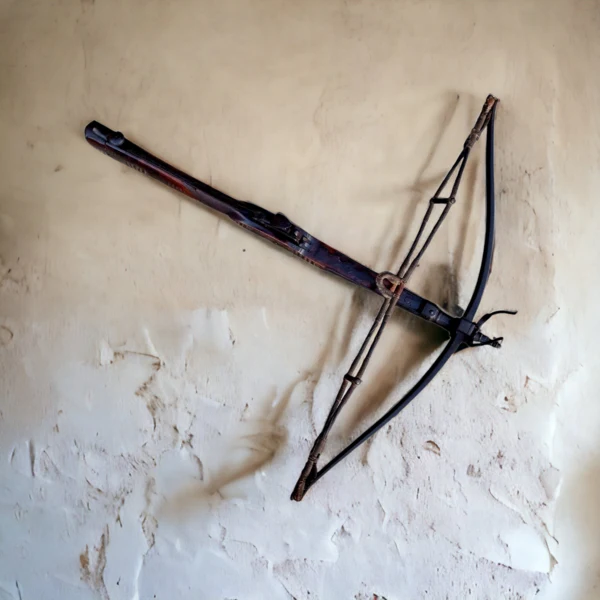
A robust mid-18th-century English stonebow, probably by Barker of Wigan, featuring a steel bow retained by a pair of long steel side plates and a central release mechanism. Originally used for hunting small game, this example is unusually complete and well-preserved, with a strong patina and functional tension.
William Barker is recorded making crossbows in Wigan, Lancashire, circa 1754-86.
Stonebows were precision tools for sportsmen and gamekeepers, designed to launch clay pellets or stones rather than bolts. Their compact power and quiet release made them ideal for hunting birds and rabbits without damaging meat or disturbing livestock.
This example reflects the mechanical ingenuity of Georgian England, combining martial aesthetics with rural practicality. A rare survival from the sporting traditions of the 18th century.
Provenance: England. Mid 18th century.
Condition: Good as per the images. Offered for sale with its original string.
Size: Length 79 cm (31")
Additional Historical Background:
Stonebows are a specialized form of crossbow adapted to fire small projectiles — typically clay pellets or stones — rather than quarrels or bolts. They emerged in Europe around the 16th century and gained popularity by the 18th century as discreet hunting weapons.
-
Purpose: Used primarily for hunting small game such as birds and rabbits. Their low-impact projectiles allowed hunters to avoid damaging meat or disturbing nearby animals.
-
Design: Typically featured a steel bow, side plates, and a central release. Some included dials or markings for calibration.
-
Craftsmanship: Makers like Durs Egg and Barker of Wigan were known for producing high-quality examples in England during the late 18th century.
-
Legacy: Stonebows remained in use into the 19th century and were sold in sporting shops well into the 1800s.
.
A robust mid-18th-century English stonebow, probably by Barker of Wigan, featuring a steel bow retained by a pair of long steel side plates and a central release mechanism. Originally used for hunting small game, this example is unusually complete and well-preserved, with a strong patina and functional tension.
William Barker is recorded making crossbows in Wigan, Lancashire, circa 1754-86.
Stonebows were precision tools for sportsmen and gamekeepers, designed to launch clay pellets or stones rather than bolts. Their compact power and quiet release made them ideal for hunting birds and rabbits without damaging meat or disturbing livestock.
This example reflects the mechanical ingenuity of Georgian England, combining martial aesthetics with rural practicality. A rare survival from the sporting traditions of the 18th century.
Provenance: England. Mid 18th century.
Condition: Good as per the images. Offered for sale with its original string.
Size: Length 79 cm (31")
Additional Historical Background:
Stonebows are a specialized form of crossbow adapted to fire small projectiles — typically clay pellets or stones — rather than quarrels or bolts. They emerged in Europe around the 16th century and gained popularity by the 18th century as discreet hunting weapons.
-
Purpose: Used primarily for hunting small game such as birds and rabbits. Their low-impact projectiles allowed hunters to avoid damaging meat or disturbing nearby animals.
-
Design: Typically featured a steel bow, side plates, and a central release. Some included dials or markings for calibration.
-
Craftsmanship: Makers like Durs Egg and Barker of Wigan were known for producing high-quality examples in England during the late 18th century.
-
Legacy: Stonebows remained in use into the 19th century and were sold in sporting shops well into the 1800s.
.
Original: $3,204.21
-70%$3,204.21
$961.26Description
A robust mid-18th-century English stonebow, probably by Barker of Wigan, featuring a steel bow retained by a pair of long steel side plates and a central release mechanism. Originally used for hunting small game, this example is unusually complete and well-preserved, with a strong patina and functional tension.
William Barker is recorded making crossbows in Wigan, Lancashire, circa 1754-86.
Stonebows were precision tools for sportsmen and gamekeepers, designed to launch clay pellets or stones rather than bolts. Their compact power and quiet release made them ideal for hunting birds and rabbits without damaging meat or disturbing livestock.
This example reflects the mechanical ingenuity of Georgian England, combining martial aesthetics with rural practicality. A rare survival from the sporting traditions of the 18th century.
Provenance: England. Mid 18th century.
Condition: Good as per the images. Offered for sale with its original string.
Size: Length 79 cm (31")
Additional Historical Background:
Stonebows are a specialized form of crossbow adapted to fire small projectiles — typically clay pellets or stones — rather than quarrels or bolts. They emerged in Europe around the 16th century and gained popularity by the 18th century as discreet hunting weapons.
-
Purpose: Used primarily for hunting small game such as birds and rabbits. Their low-impact projectiles allowed hunters to avoid damaging meat or disturbing nearby animals.
-
Design: Typically featured a steel bow, side plates, and a central release. Some included dials or markings for calibration.
-
Craftsmanship: Makers like Durs Egg and Barker of Wigan were known for producing high-quality examples in England during the late 18th century.
-
Legacy: Stonebows remained in use into the 19th century and were sold in sporting shops well into the 1800s.
.